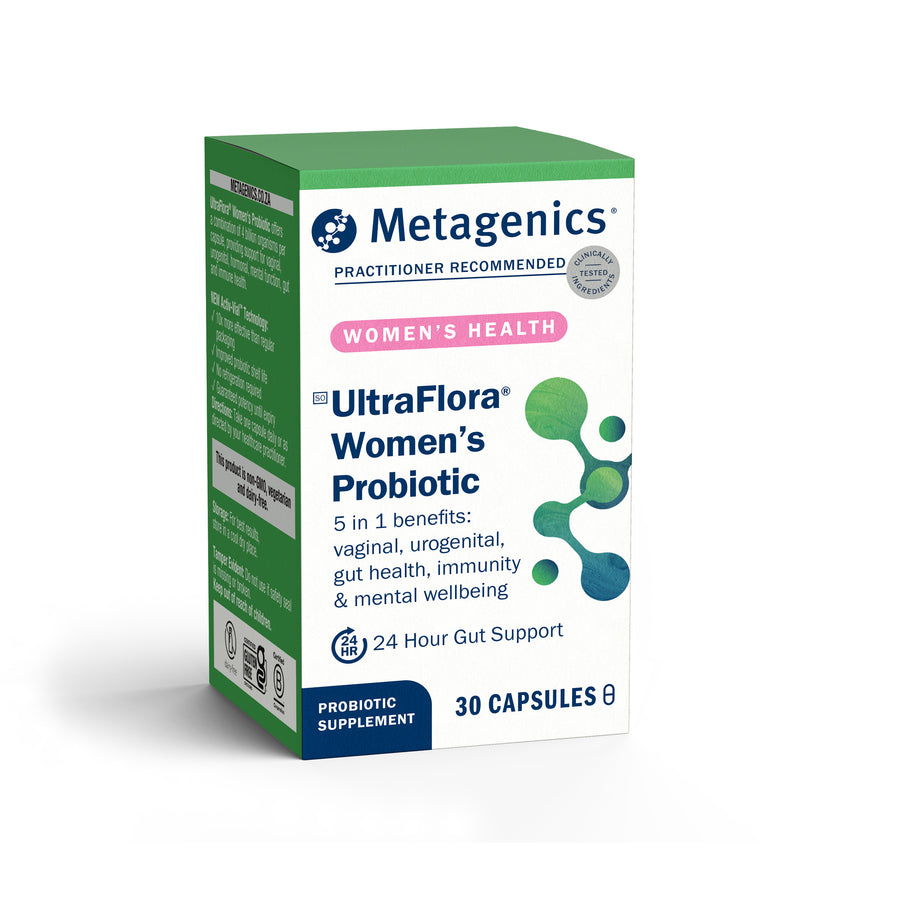
What is UltraFlora Women's Probiotic?
Metagenics South Africa describes this as a complementary medicine intended for adult use. The manufacturer says the formula is vegetarian and free from GMOs, gluten, dairy and sugar, and that its Activ-Vial packaging is designed to protect probiotic viability without refrigeration. These are product and packaging claims; they do not by themselves establish a clinical health benefit.
Which ingredients are listed?
The South African manufacturer's product page lists the following active ingredients per capsule:
- Lactiplantibacillus plantarum Lpla33 — 1 billion CFU.
- Bifidobacterium lactis BB-12 — 1 billion CFU.
- Lactobacillus rhamnosus — 1 billion CFU.
- Lactobacillus reuteri — 1 billion CFU.
- A probiotic combination — listed as 2 billion CFU.
- Vitamin B2 (riboflavin) — 350 micrograms.
- Vitamin B6 — 350 micrograms, listed as pyridoxal-5-phosphate.
- Vitamin D3 — 1.25 micrograms (50 IU).
Other ingredients listed by the manufacturer are hydroxypropyl methylcellulose, magnesium salts of fatty acids, microcrystalline cellulose and silicon dioxide.
What does the research say about vaginal health?
Vaginal microbiomes vary naturally, and different Lactobacillus strains can behave differently. A small randomised, placebo-controlled trial published in 2003 studied oral Lactobacillus rhamnosus GR-1 and Lactobacillus fermentum RC-14 in 64 healthy women. It reported a change towards lactobacilli-dominant vaginal flora in some participants. That is an interesting finding, but it is a small, older study and does not establish that every probiotic product has the same effect or can prevent or cure infection.
Evidence for probiotics in bacterial vaginosis is mixed. The US Centers for Disease Control and Prevention's STI Treatment Guidelines state that currently available studies do not support probiotic products as an adjunct or replacement therapy for women with bacterial vaginosis. A probiotic should therefore not be promoted as a proven treatment for BV or as a substitute for an appropriate clinical assessment.
What about urinary, gut and immune health?
Probiotics are not interchangeable: their effects depend on the strain, dose, formulation and condition being studied. Research about one strain or one specific formulation cannot automatically be applied to the entire category. The presence of probiotics in a capsule is not proof that it prevents urinary tract infections or treats urinary symptoms.
The product also contains vitamins B2, B6 and D. These nutrients have normal roles in the body, but the small amounts in this formula do not establish a specific benefit for mental function, immunity or energy in someone who already gets enough of those nutrients. We found no basis to describe this exact product as proven to enhance mental function.
Does Activ-Vial mean “10 times more effective”?
Packaging designed to reduce moisture exposure can help protect live cultures during storage. However, a claim about packaging performance is not the same as evidence that a supplement produces ten times the health benefit. The practical point is to follow the current label's storage directions and check the stated expiry date and guaranteed potency information.
Safety and when to seek care
- The product is intended for adults. It is not intended for children or teenagers.
- Ask a qualified healthcare professional before use if pregnant or breastfeeding, taking medication, or managing a medical condition.
- People with serious underlying illness or weakened immune systems should ask their clinician before using probiotics.
- Do not use a probiotic instead of recommended treatment for bacterial vaginosis, a urinary tract infection or another diagnosed condition.
- New or persistent vaginal discharge, odour, itching, burning or pain can have different causes. Seek healthcare advice rather than assuming a microbiome imbalance.
- Urinary symptoms with fever, back or side pain, vomiting, or blood in the urine need prompt medical assessment. Seek urgent help for severe symptoms.
Product details
The supplied retailer listing describes 30 capsules, one capsule daily, a plastic container and a product of the EU. It says no refrigeration is required and recommends storage in a cool, dry place. Follow the current packaging instructions rather than assuming all probiotic products have identical storage requirements.
View the retailer's product listing
Our take
UltraFlora Women's Probiotic brings together several named probiotic organisms and vitamins in a daily capsule, with packaging designed for shelf stability. The most important caveat is that probiotic effects are strain-specific, the published South African ingredient listing appears inconsistent about the total CFU count, and the evidence does not establish this exact product as a treatment for vaginal or urinary infections. For ongoing symptoms, a healthcare professional is a better starting point than self-treating with a supplement.
Sources and further reading
- Metagenics South Africa: UltraFlora Women's Probiotic — current local product information, ingredients and manufacturer disclaimer.
- Metagenics South Africa: Professional Information PDF — formulation and product information.
- US Centers for Disease Control and Prevention: Bacterial Vaginosis — STI Treatment Guidelines — evidence and treatment recommendations, including the limits of probiotic evidence.
- Reid et al. (2003): Oral use of Lactobacillus rhamnosus GR-1 and L. fermentum RC-14 in healthy women — small randomised, placebo-controlled study of vaginal flora.